

Motivational Interviewing for Addiction Recovery: How We Help People Build Lasting Motivation
Motivational Interviewing (MI) is a person-centered counseling style that helps people work through mixed feelings about substance use and strengthen their own reasons to pursue recovery. This guide walks through how MI works, its core principles and OARS micro-skills, and where it fits alongside detox, inpatient care, and treatment for co-occurring conditions. In early recovery many people feel pulled between familiar substance use and a desire for change; MI turns that inner conflict into clear, self-directed goals and practical next steps. You’ll learn how MI maps to the Stages of Change model, example clinician prompts that draw out “change talk,” the evidence-backed benefits like increased engagement and relapse prevention, and how MI is used in clinical care. We’ll also cover who typically benefits from MI and simple ways families can support a loved one using MI-style communication. After a concise overview of MI theory and techniques, the article reviews clinical applications and practical next steps for getting treatment and sustaining recovery.
What is Motivational Interviewing and How Does It Support Addiction Recovery?
Motivational Interviewing is a collaborative, goal-focused approach that helps people find and strengthen their own motivation to change by resolving ambivalence and building confidence. MI relies on empathic listening, targeted questions, and reflective responses that encourage clients to voice their reasons for change—those expressions of “change talk” are strong predictors of later behavior change. Typical MI sessions explore values, highlight gaps between current behavior and long-term goals, and establish small, achievable steps toward recovery. MI can be a brief intervention or part of a longer residential or outpatient plan to prepare people for other evidence-based therapies and to improve retention. Many treatment providers make MI a standard element of individualized care; programs in Las Vegas often use it to ease transitions between levels of care and to support readiness for therapies like CBT or medical treatment.
MI typically delivers three direct clinical benefits for people in recovery:
- Greater engagement: When clients name their own reasons for change, they’re more likely to show up and stay in treatment.
- Less ambivalence: Structured reflection turns uncertainty into actionable motivation.
- Stronger self-efficacy: Setting and succeeding at small goals builds confidence for longer-term recovery.
These benefits create a solid base for additional therapeutic work. Next, we’ll look at MI’s origins and its guiding principles.
Who Developed Motivational Interviewing and What Are Its Core Principles?
Motivational Interviewing was developed by William R. Miller and Stephen Rollnick in the early 1980s as an alternative to confrontational, directive methods that often increased resistance. The founders emphasized a collaborative, evocative stance: the clinician’s job is to draw out the client’s own reasons for change, not to impose them. A handy way to remember MI’s core principles is D.E.A.R.: Develop discrepancy, Express empathy, Avoid argument (roll with resistance), and Reinforce self-efficacy. Each principle plays a role: empathy builds trust, discrepancy creates motivating tension, rolling with resistance prevents escalation, and supporting self-efficacy fosters belief in the ability to change. Knowing these ideas helps clinicians pick the right micro-skills and keep a nonjudgmental, guiding conversational style.
Those principles naturally lead into the OARS micro-skills clinicians use in sessions—the practical moves that make MI work.
How Does Motivational Interviewing Address Ambivalence in Recovery?
Ambivalence—wanting and not wanting change at the same time—is central to addiction and a frequent barrier to action. MI tackles ambivalence by inviting people to weigh pros and cons in a structured, nonconfrontational way that respects their autonomy. Clinicians use open questions, reflective listening, and focused summaries to amplify change talk and soften sustain talk, shifting the conversation toward client-generated reasons to change. For example, if a client fears withdrawal but also wants to rebuild family ties, a clinician might reflect that value and ask what a realistic first step could look like—often the client then names a concrete action. Turning internal conflict into specific goals and strategies reduces paralysis and opens a path to treatment.
Working through ambivalence also makes people more ready for intensive interventions, so MI often serves as a practical lead-in to detox, medications, or behavioral therapies.
What Are the Four Principles and OARS Techniques of Motivational Interviewing?
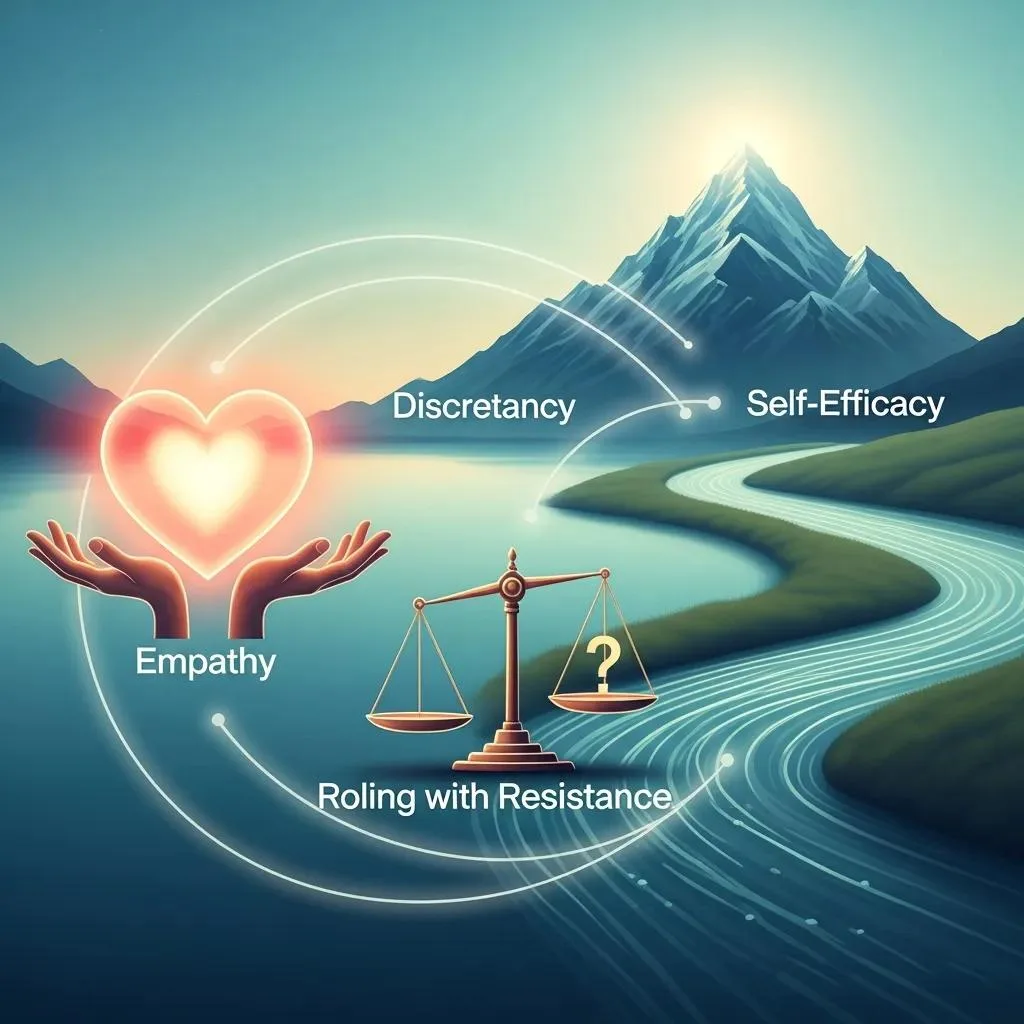
The four guiding principles shape how clinicians position themselves and choose interventions: Express Empathy, Develop Discrepancy, Roll with Resistance, and Support Self‑Efficacy. Expressing empathy creates safety and reduces defensiveness. Developing discrepancy helps people see the gap between current behavior and their important goals. Rolling with resistance avoids power struggles and treats reluctance as useful information. Supporting self‑efficacy builds confidence through achievable steps and recognition of past successes. Together, these principles form the foundation for MI sessions and guide when to lead and when to follow the client’s direction.
Here’s a short summary of the four principles with what they mean in practice:
- Express Empathy: Use reflective listening to build rapport and encourage honest sharing.
- Develop Discrepancy: Gently highlight differences between current behavior and personal goals to spark motivation.
- Roll with Resistance: Avoid arguing; use resistance as a cue to change approach rather than escalate.
- Support Self‑Efficacy: Boost belief in change by setting achievable goals and affirming strengths.
With those principles in mind, clinicians apply the OARS micro-skills to carry MI conversations forward.
How Does Expressing Empathy and Developing Discrepancy Facilitate Change?
Expressing empathy builds the therapeutic alliance by validating the person’s experience and showing genuine understanding; this reduces shame and opens space for honest self-reflection. Using thoughtful reflections and curious, nonjudgmental questions helps people feel safe to explore their values and mixed feelings. Developing discrepancy uses that trust to point out gently how current behaviors differ from the client’s stated hopes—family connection, work stability, health—creating internal pressure to consider change. Careful phrasing matters: a reflection that names values followed by a question about the cost of continued use invites change talk without confrontation. When empathy comes first, discrepancy is more likely to be heard as self-directed insight rather than an external demand, which supports follow-through on next steps.
These shifts in the conversation are key to MI’s ability to promote lasting motivation and to prepare for behavior change work.
What Are Open-Ended Questions, Affirmations, Reflective Listening, and Summaries?
OARS are the micro-skills that turn MI principles into real conversation: Open‑ended questions invite fuller responses; Affirmations notice strengths; Reflective listening mirrors meaning to deepen understanding; and Summaries pull ideas together and reinforce change talk. Open questions encourage people to explain values and intentions instead of yes/no answers. Affirmations highlight effort and past successes, which strengthens confidence. Reflective listening—simple, complex, and amplified—helps people hear their own thinking and often leads to new insights. Summaries collect important themes and next steps, creating momentum toward action.
Clinicians and family members can try a few practical prompts:
- Open‑Ended Question: “What would feel different in your life if you cut back on using?”
- Affirmation: “You showed real persistence getting here today despite feeling anxious.”
- Reflective Listening: “It sounds like you want stability but you also miss the comfort using brought.”
- Summary: “You value your relationships, you’ve tried before, and you’re thinking about small steps like reducing use to see what changes.”
How Does Motivational Interviewing Integrate with the Stages of Change Model in Addiction?
Motivational Interviewing maps naturally to the Stages of Change by matching clinician goals and moves to where a person is in the process: Precontemplation, Contemplation, Preparation, Action, and Maintenance. In Precontemplation the focus is on engagement and raising awareness without pressure. In Contemplation clinicians help people weigh pros and cons and draw out change talk. Preparation is about turning motivation into practical planning and small steps. In Action the work centers on reinforcing change and solving barriers. Maintenance focuses on relapse prevention and sustaining confidence. Aligning MI strategies with each stage keeps interventions respectful of readiness while offering the right support to move forward.
The table below pairs stages with MI approaches and typical clinical goals for quick reference.
What Are the Stages of Change and How Does MI Adapt to Each Stage?
The Stages of Change framework describes typical readiness levels and gives clinicians a roadmap for MI-consistent interventions. In Precontemplation the clinician works to build rapport and gently raise awareness through nonjudgmental questions rather than pushing for immediate action. In Contemplation decisional-balance exercises and evocative questions help clients voice their reasons for and against change. Preparation turns motivation into practical steps—MI supports small, achievable goals to build confidence. Action focuses on reinforcing progress and teaching coping skills; Maintenance centers on relapse prevention and nurturing a recovery identity. Using MI moves that match the client’s stage reduces mismatch and increases the chance of ongoing engagement.
How Does MI Enhance Intrinsic Motivation and Self‑Efficacy During Recovery?
MI strengthens intrinsic motivation by helping people identify reasons for change that matter to them personally, shifting motivation away from external pressure toward internal values. Self‑efficacy grows when clinicians support small, achievable steps and point out strengths and past wins. Tools like scaling questions (for example, “On a scale of 1–10, how confident are you?”) combined with problem‑solving foster incremental mastery. Research and clinical consensus point to MI’s focus on autonomy and competence as a key pathway from conversation to behavior change. Practical steps—short experiments, celebrating small wins, and revisiting values—help translate motivation into sustainable action and resilience against relapse.
That’s why MI works well as both a preparatory and an adjunctive approach across treatment settings.
What Are the Benefits of Motivational Interviewing for Addiction Recovery?

Motivational Interviewing produces measurable benefits in engagement, retention, and readiness for further treatment by reducing resistance and increasing client-driven goals. MI helps boost attendance and willingness to join additional therapies, often serving as a bridge into more intensive options like behavioral therapies or medication-assisted treatment. Clinically, MI is linked to lower dropout rates and stronger therapeutic alliances—factors that improve outcomes after treatment. MI’s brief, focused approach also makes it useful in detox, inpatient programs, and outpatient clinics as part of a comprehensive care plan.
Below is a quick comparison of common MI benefits and the outcomes they influence.
How Does MI Reduce Relapse Risk and Increase Treatment Engagement?
MI helps lower relapse risk by strengthening a person’s commitment to change and by building practical coping plans through collaborative problem‑solving. Eliciting change talk reinforces intentions that predict follow‑through, while supporting self‑efficacy increases confidence in managing cravings and high‑risk situations. MI also makes treatment feel more personally relevant, which improves attendance and participation. MI on its own is not a cure, but when combined with medical detox, inpatient care, and targeted behavioral therapies it enhances the effectiveness of a comprehensive treatment plan. Clinicians should treat MI as an engagement tool that prepares people for each step of care and helps sustain them through transitions.
In What Ways Does MI Foster Long‑Term Sobriety and Confidence?
Over time, MI supports sobriety by helping people internalize recovery goals and build sustainable coping strategies and a recovery-oriented identity. MI focuses on small, measurable steps that create a track record of success; those wins accumulate and strengthen self‑efficacy. Aftercare informed by MI commonly includes brief follow‑up sessions, peer support participation, and periodic check‑ins to renew motivation during risky periods. Sustained progress also relies on relapse‑prevention planning integrated with clinical supports. When MI is used to scaffold other treatments, people are more likely to stay connected to care and apply tools in daily life.
Signs of long-term success include continued engagement with supports, regular use of coping strategies, and the ability to articulate personal reasons for staying in recovery.
How Is Motivational Interviewing Applied at BetterChoice Treatment Center in Las Vegas?
At BetterChoice Treatment Center we weave Motivational Interviewing into multiple levels of care so people in Nevada can find timely options and build individualized recovery plans. MI is part of intake to assess readiness and set immediate, realistic goals; it’s used during medical detox to address concerns about withdrawal and encourage engagement with follow‑up therapies. In inpatient rehab MI appears in both one‑to‑one sessions and group work to reinforce personal goals and prepare patients for discharge and aftercare. Our approach emphasizes straightforward guidance, building trust, and helping without pressure. A multidisciplinary team tailors MI to each person’s needs, and our accreditation and staff credentials support consistent, clinically sound delivery.
How Is MI Integrated into Medical Detox, Inpatient Rehab, and Co‑Occurring Disorder Programs?
In medical detox, MI helps clinicians explore worries about withdrawal and gently encourage acceptance of medical support, while always prioritizing safety and privacy. In inpatient rehab clinicians use MI in individual and group formats to elicit recovery goals and to guide discharge planning and aftercare. For co‑occurring disorders, MI complements psychiatric assessment and evidence‑based treatments by aligning substance‑related goals with mental health objectives and ensuring coordinated care. Typical pathways start with an MI‑informed intake, continue with repeated MI sessions during stabilization, and end with MI‑driven discharge planning focused on realistic next steps and referrals. Throughout, patient autonomy and confidentiality are respected.
Who Are the Expert Therapists Delivering MI at BetterChoice Treatment Center?
BetterChoice’s multidisciplinary team includes clinical leaders and staff who oversee quality and treatment delivery. Publicly listed team members include Ani Alvadzhyan (Quality Assurance), Brian Kaszuba (Doctor/Medical Director), Jim Jobin (Clinical Director/LCPC), and Wyconda Hopkins (CADC‑I). These clinicians work alongside medical and counseling staff to ensure MI is used consistently and to align motivational work with detox, psychotherapy, and co‑occurring disorder treatment. Our teams coordinate care plans, monitor progress, and involve families when appropriate—always emphasizing trust and supportive guidance without sales pressure. For more information about roles and program structure, please see BetterChoice’s public profiles and facility details.
Who Can Benefit from Motivational Interviewing and What Are Common Questions About MI?
Motivational Interviewing helps a wide range of people affected by substance use disorders: those unsure about change, people preparing for detox or rehab, and individuals managing co‑occurring mental health conditions. MI is especially helpful for clients who might otherwise avoid treatment or disengage early because it reduces resistance and promotes personal ownership of goals. Families and support networks also benefit from learning MI‑aligned communication techniques that lower conflict and encourage supportive conversation. When thinking about treatment, MI can clarify options and readiness, and it pairs well with other interventions as part of a complete recovery plan.
Is Motivational Interviewing Safe and Effective for All Types of Addiction?
Yes—MI is broadly safe and evidence‑based across many substance use disorders when provided by trained clinicians. Its nonjudgmental style minimizes psychological risk, and MI is most effective when combined with other treatments such as medical detox, medication‑assisted treatment, or cognitive‑behavioral therapy for longer‑term recovery. Limitations include the need for skilled delivery and the recognition that MI alone may not be enough for severe dependence without medical or psychosocial supports. In practice, MI is a flexible tool to increase engagement and prepare people for more intensive, evidence‑based care. Clinicians should evaluate each person’s needs and combine MI with appropriate medical and behavioral interventions when necessary.
How Can Family Members Support Loved Ones Through MI‑Based Recovery?
Families can help by using MI‑consistent behaviors: listen reflectively, avoid judgment and lectures, and support small, realistic goals rather than demanding immediate change. Practical do’s and don’ts make it easier to support recovery while protecting relationships and respecting privacy during intake and treatment. Families can also assist with concrete tasks like researching treatment options, helping with appointments, and supporting insurance or referral conversations when appropriate. If privacy is a concern, providers can explain intake procedures and confidentiality safeguards so families can support within respectful boundaries.
- Dos for families supporting MI‑based recovery:
Listen reflectively to show understanding and lower defensiveness.
Affirm small steps to build confidence and encourage progress.
Offer practical help such as transport or appointment support. - Don’ts to avoid during conversations about change:
Skip lectures or ultimatums—these often increase resistance.
Don’t assume motives; ask open questions instead of guessing.
Avoid public shaming or confrontational tactics that erode trust.
These simple shifts create room for helpful conversations that move toward action rather than conflict.
If families are ready to explore treatment options, BetterChoice Treatment Center offers informational pathways and public facility profiles that explain program components, intake steps, and privacy safeguards.
This article has covered MI’s theoretical base, practical skills, stage‑specific applications, evidence‑informed benefits, and how MI is used in Las Vegas clinical programs to support people seeking recovery.
Frequently Asked Questions
What types of addiction can benefit from Motivational Interviewing?
Motivational Interviewing is effective for many substance use disorders, including alcohol, opioids, stimulants, and others. It’s especially helpful for people who feel unsure about change or reluctant to start treatment. MI’s nonjudgmental style helps clients clarify their motivations and concerns, and it can be adapted for people with co‑occurring mental health issues, making it useful across different settings and treatment approaches.
How can MI be integrated into aftercare plans for addiction recovery?
MI plays a key role in aftercare by helping clients stay motivated and committed to recovery goals. Aftercare often includes regular check‑ins, support groups, and ongoing therapy—settings where MI techniques can reinforce intrinsic motivation. Setting small, achievable goals and celebrating wins helps people handle setbacks and reduce relapse risk. Ongoing MI‑informed support fosters accountability and helps clients keep sight of their reasons for staying sober, which supports long‑term recovery.
Can MI be used in group therapy settings?
Yes. MI can be used effectively in group settings where clinicians guide discussions that encourage participants to share motivations and challenges. MI techniques like reflective listening and open questions help create a supportive atmosphere where people feel safe to speak. Group MI can strengthen peer support, let members learn from one another, and reinforce commitment to change through shared goals and mutual encouragement.
What role does self‑efficacy play in the success of MI?
Self‑efficacy—the belief you can succeed—is central to MI. MI builds self‑efficacy by helping clients set and achieve small, manageable goals, which gradually increases confidence. When people recognize their strengths and past successes, they’re more likely to believe in their ability to change. Higher self‑efficacy motivates engagement in treatment and provides resilience when facing challenges during recovery.
How does MI address the needs of families in the recovery process?
MI recognizes families as important partners in recovery. It gives families communication tools—like reflective listening and affirmations—that reduce conflict and encourage supportive dialogue. Families can learn to set realistic expectations and offer practical help, which enhances the recovery process. MI‑based guidance helps families support loved ones in a way that preserves dignity and strengthens connection.
What are some common misconceptions about Motivational Interviewing?
One common misconception is that MI is a persuasion technique; in reality it’s collaborative and respects the client’s autonomy. Another misconception is that MI only works for mild substance problems—research shows it can be helpful across severity levels when used alongside other treatments. Recognizing these nuances helps clinicians and clients use MI effectively within comprehensive care plans.
Conclusion
Motivational Interviewing helps people in addiction recovery by increasing engagement, reducing ambivalence, and strengthening confidence to change. This evidence‑based approach clarifies personal reasons for change and prepares clients for further therapy. When MI is integrated into treatment plans, clinicians and families can better support lasting recovery and resilience. Learn how BetterChoice Treatment Center can help you or a loved one take the next step toward recovery today.